
Impact of Varying Wall Temperature on Hypersonic Boundary Layers
Where: Aerospace Sciences Laboratory, Purdue University
Advisor: Prof. Brandon Chynoweth
Tools: STABL, DPLR2D, PSE-Chem, MATLAB, Tecplot, BAM6QT wind tunnel
The problem
Predicting where a hypersonic boundary layer transitions from laminar to turbulent is critical to vehicle design. At the same location on the vehicle, heat transfer to the skin is roughly three to five times higher when the flow is turbulent than when it is laminar. Transition location therefore drives the design of the thermal protection system.
Real vehicle surfaces are not held at a single uniform temperature. My research asks how varying wall temperature profiles change the boundary layer and where it transitions.
Current work: flared cone
I am now investigating how varying wall temperature affects the boundary layer as a whole, not only the transition location, using a flared cone geometry.
- Running computational analyses of the flared cone in STABL.
- Connecting the computations to physical experiments in the BAM6QT, so the predictions can be compared with wind tunnel measurements.
First study: sharp cone
My first project looked at how varying wall temperature affects boundary-layer transition on a sharp cone.
- Ran mean-flow simulations of a sharp cone in hypersonic flight with DPLR2D, part of the Stability and Transition Analysis for Hypersonic Boundary Layers (STABL) suite.
- Ran linear stability analysis with PSE-Chem to track the growth of boundary-layer instabilities under different wall temperature distributions.
- Post-processed and compared results with MATLAB scripts and Tecplot visualizations.
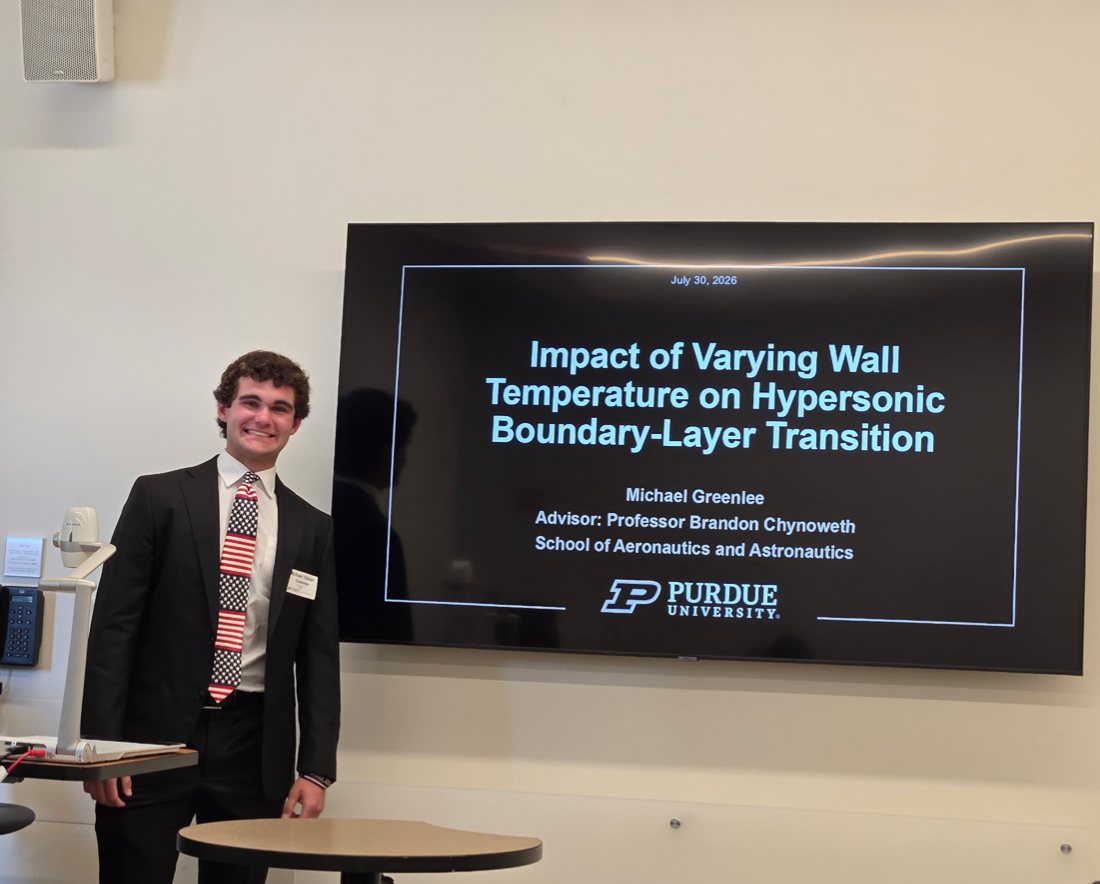
- Presented the results in my first research talk, Impact of Varying Wall Temperature on Hypersonic Boundary-Layer Transition, at the 2026 Purdue Summer Undergraduate Research Symposium.
Wind tunnel work
I am also an assistant in the Boeing/AFOSR Mach-6 Quiet Tunnel (BAM6QT), and I am working toward certification to run future experiments.